
Why We Need Digital Marketing in Today’s World
In the modern economic ecosystem, the traditional boundaries of commerce have fundamentally dissolved. We live in a hyper-connected, digital-first world where consumers wake up to smartphone notifications, spend their workdays on cloud-connected devices, and relax by streaming media or scrolling through social channels. Search engine query volumes span billions daily, and consumer discovery happens on screens large and small.
In this environment, relying solely on traditional marketing channels—such as billboards, print newspapers, or television commercials—is like trying to run a race with a tied shoe. Digital marketing has transformed from an innovative growth lever into an imperative core infrastructure for businesses of every scale.
Understanding why digital marketing is indispensable requires examining consumer behavior, operational efficiency, technology evolution, and brand sustainability.
1. Meeting Consumers Where They Live: The Multi-Platform Landscape
The fundamental premise of marketing has always been simple: put your message where your audience’s attention is focused.
In today’s ecosystem, consumer attention lives online. Discovery no longer occurs through a single front door; it happens across search engines, social media platforms, short-form video ecosystems, and generative AI platforms. Consumers rely on digital channels to evaluate options, research reviews, compare features, and validate brand authenticity before spending a single dollar.
If a business does not maintain an active, optimized digital footprint across these touchpoints, it effectively ceases to exist for a massive segment of its target market.
2. Unparalleled Precision and Micro-Targeting
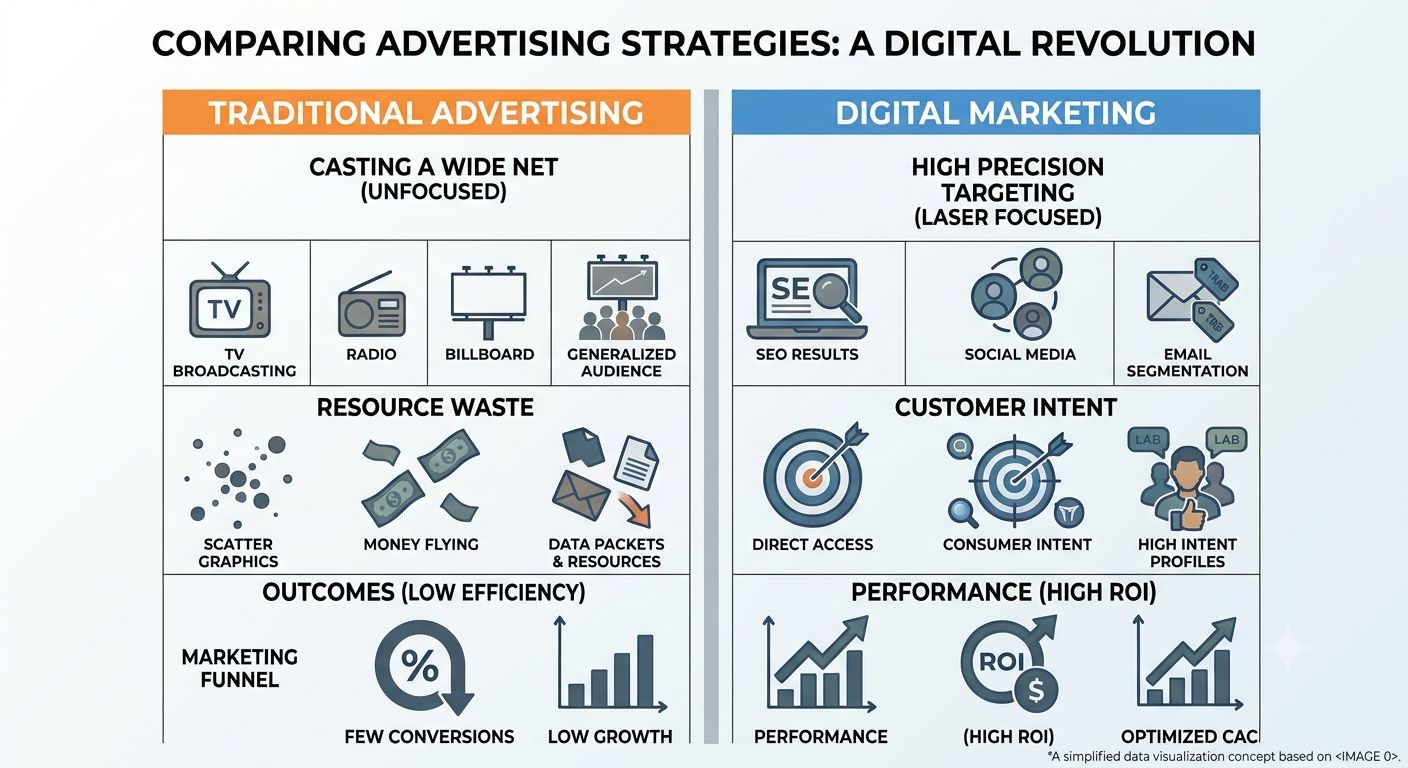
One of the largest flaws of traditional advertising is its reliance on broad, wasteful reach. Broadcasting a TV commercial or renting a billboard means paying to reach thousands of people who will never have an interest in your product.
Digital marketing solves this waste through precise targeting capabilities:
-
Intent-Based Alignment: Search engine optimization (SEO) and search ads target people actively seeking specific solutions right at the moment of intent.
-
Behavioral & Interest Segmenting: Digital platforms allow brands to segment audiences based on specific online behavior, purchase history, interest clusters, and demographics.
-
Custom & Lookalike Audiences: First-party data lets businesses re-engage past buyers or identify new prospects matching their ideal customer profile.
3. Data-Driven Insights and Agility in Real Time
Historically, calculating the return on investment (ROI) of a marketing campaign required waiting months for post-campaign surveys or sales reports. Digital marketing replaces guesswork with real-time measurement and actionable analytics.
With modern analytics frameworks, businesses can monitor exact metrics minute-by-minute:
-
Click-through rates (CTR) and impression shares
-
Cost per acquisition (CPA) and customer lifetime value (LTV)
-
Conversion path mapping and multi-touch attribution
This granularity enables unprecedented operational agility. If a creative asset underperforms, it can be swapped out within minutes. If a specific campaign shows exceptional ROI, budgets can be immediately scaled toward the winning variant.
4. Cost Efficiency and Democratized Competition
For startups and small-to-medium enterprises (SMEs), traditional advertising channels often carry prohibitive entry costs. A national TV spot or prime print page requires massive capital outlays upfront.
Digital marketing levels the playing field:
| Marketing Channel | Entry Barrier | Scalability | Cost Flexibility |
| Traditional (TV/Print/Out-of-Home) | High capital upfront | Linear / Rigid | Fixed production and ad placement fees |
| Digital (Search/Paid Social/Content) | Low / Accessible to any budget | Exponential / Instant | Pay-per-performance; micro-budget testing |
By leveraging targeted digital content, organic search strategies, and community-first social channels, a small enterprise can out-position a multi-national conglomerate in niche markets.
5. The Power of Personalization and Customer Journey Orchestration
Modern consumers expect brands to know what they need, when they need it, and how they want it delivered. Modern digital strategy delivers hyper-personalization across every stage of the customer lifecycle:
-
Discovery: AI-driven algorithms show relevant product options based on browsing intent.
-
Nurturing: Dynamic email workflows deliver customized resources based on specific user interactions.
-
Retention: Personalized loyalty offers and automated follow-ups drive repeat orders and higher customer lifetime value.
Seamless omnichannel experiences build customer trust, lower friction, and increase long-term brand equity.
6. The Rise of AI and Automation
Artificial Intelligence has transformed digital marketing into an automated, predictive powerhouse.
Modern digital marketing strategies leverage AI to:
-
Automate Campaign Execution: AI engines handle complex real-time bidding, budget allocation, and target refinements automatically.
-
Accelerate Creative Output: Generative tools assist human teams in producing variations of copy, images, and visual assets faster.
-
Predict Customer Behavior: Machine learning models analyze historical user data to anticipate churn, score leads, and forecast upcoming demand patterns.
Businesses that adopt these technologies optimize campaign efficiency by 20–30%, stretching every marketing dollar further.
7. Building Authentic Trust Through Authority & Community
Consumers have developed strong skepticism toward corporate messaging. They seek authentic proof, expert validation, and community feedback before making purchasing decisions.
Digital marketing provides the ideal ecosystem to build this “Trust Moat”:
-
Content Marketing & SEO: High-quality blog content, whitepapers, and guides answer real customer questions, positioning the brand as a trusted authority.
-
User-Generated Content (UGC): Real customer reviews, unboxing videos, and creator recommendations offer authentic social proof.
-
Founder-Led & Social Communities: Direct conversation on community channels builds human relationships between brand leaders and their customer base.
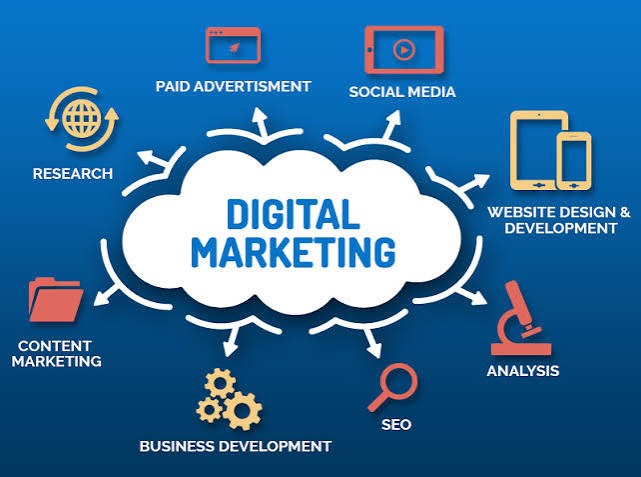
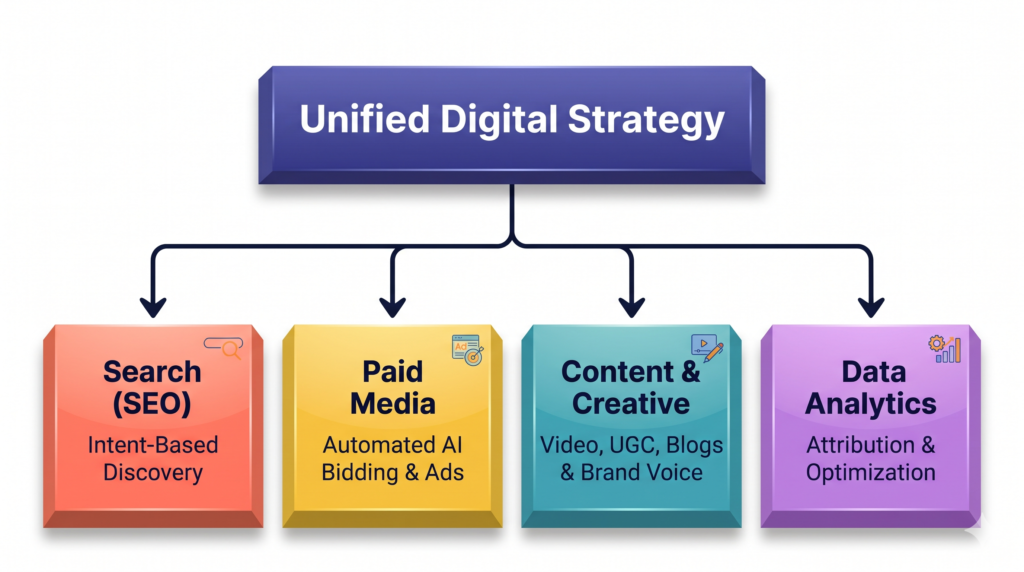
The Core Deliverables of a Modern Digital Marketing Ecosystem
To succeed today, an organization must connect multiple digital elements into a unified engine:
Moving Forward
Digital marketing is no longer a separate line item on an enterprise operational checklist—it is the digital foundation of modern commerce.
Whether building brand authority through search engines, scaling ad performance with AI, or cultivating authentic customer communities, digital strategies provide the reach, precision, agility, and measurable ROI required to grow in today’s marketplace. Organizations that embrace this ecosystem build sustainable competitive advantages, while those that ignore it risk becoming invisible to the modern consumer.